Welcome to the World, Casauria DOCG!

Map of Abruzzo via Federdoc. The new Casauria DOCG will encompass areas in the center of the province, inland from the town of Pescara

Wine geeks of the world, unite! Today is your lucky day! Italy has officially announced a new Denominazione di Origine Controllata e Garantita for wine: Casauria DOCG. The application for this new appellation has been in the works for about two years, and on November 11 (2025), the EU made it official. The appellation is named for the Abbey of San Clemente a Casauria, built in the town of Pescara in 871 by Louis II, great-grandson of Charlemagne.

This is Italy’s 79th DOCG for wine to date, and the third for the province of Abruzzo (joining Colline Teramane Montepulciano d’Abruzzo DOCG and Tullum/Terre Tollesi DOCG). The area encompassing the new Casauria DOCG is situated in the foothills of the Apennines inland from fhe coastal town of Pescara. Vineyards must be located in areas that receive plenty of sun at elevations up to 600 meters/1,970 feet above sea level. The Casauria DOCG overlaps (and was formerly a sub-zone of) the Montepulciano d’Abruzzo DOC.

The Casauria DOCG is approved for dry red wines only. According to the standards of production, it typically shows an intense ruby red color, with younger wines having flecks of violet and older wines showing garnet around the edge. Young wines should show aromas of ripe red fruit and spice. Older wines, and those (optionally) aged in oak will show increased complexity and notes of wood.

  • Other production standards for the Casauria DOCG include the following:
    • Grape variety: 100% Montepulciano
    • Minimum alcohol by volume: 13%; 13.5% for Riserva
    • Aging: The wine must be aged for a minimum of 18 months before being released to distribution.
      • Wines designated as Riserva must be aged for a minimum of 24 months, calculated beginning on November 1 of the harvest year.
    • Production, aging, and bottling must occur within the designated production zone.

Welcome to the world, Casauria DOCG! We can’t wait to find a bottle!

References/for more information:

Post authored by Jane A. Nickles…your blog administrator: jnickles@societyofwineeducators.org


Appellation Roulette: Graves Supérieures AOC Declassified!

We’re just here to say good-bye.

News flash for French wine lovers and all students of wine! As of this month (October 2025), the Graves Supérieures AOC has been declassified by the INAO (Institut National de l’Origine et de la Qualité/French National Institute of Origin and Quality) and cancelled by the EU. To put it simply, the Graves Supérieures AOC is no more.

The Graves Supérieures AOC, established in 1937 and located in the southern reaches of Bordeaux’s Left Bank, originally allowed for the production of just one style of wine: sweet, botrytis-affected white wines containing the standard white grapes of Bordeaux.

Sweet white wine lovers—have no fear. These wines are still being produced and the parameters surrounding them have not changed. However, moving forward, they will be bottled under the Graves AOC. The Graves AOC will also continue to be approved for dry red wines and dry white wines.

  • The requirements for sweet white wines (white wine with residual sugar) produced under the Graves AOC, as amended, include the following:
    • Allowed grape varieties: Sémillon, Sauvignon Blanc, Sauvignon Gris, and Muscadelle—grapes must be “overripe” and harvested by hand in successive selections, (Note: the cahier des charges mentions “mainly Sémillon” and the presence of botrytis with no further details.)
    • Minimum potential alcohol: 13.5%
    • The use of rectified grape must and chaptalization is allowed.
    • Minimum residual sugar: 34 g/l

These wines are intended to be “round, generous wines of a golden color with aromas of candied fruit.” Those of us who have been lucky enough to taste one will also say that they are complex, somewhat earthy, delicious, and a great match for pear-based desserts and blue cheese.

References/for more information:

Post authored by Jane A. Nickles…your blog administrator: jnickles@societyofwineeducators.org

Welcome to the World, Vino de Pago Tharsys!

Photo via pagodetharsys.com

Spain’s Ministry of Agriculture, Fisheries and Food (Ministerio de Agricultura, Pesca y Alimentación, MAPA) has announced the approval of a new Denominación de Origen Protegida (PDO) for wine: the Vino de Pago Tharsys! As of October 2 (2025) the EU has also announced its approval of the new appellation. At last count, this makes for a new total of 28 vinos de pago for Spain.

The new appellation is located near the town of Requena, within the western portion of the region (comunidad autónoma) of Valencia. Vineyards and wine production were present in the area as early as the 16th century. A large estate with seven houses, a flour mill, and extensive vineyard holdings was producing wine in the area until 1950. In 1998, new owners revived the vineyards and adopted the original name of the estate (Tharsys).

The Vino de Pago Tharsys is approved for the production of red (tinto), white (blanco), rosé (rosado), and quality sparkling wine (vino espumoso de calidad). The specific regulations for these wines are as follows:

  • Tinto (red wine):
    • May be monovarietal Merlot, Cabernet Franc, or Bobal
    • May be a blended wine using any proportions of the following varieties: Merlot, Cabernet Franc, Bobal, Tempranillo, and/or Garnacha Tinta
    • These must be dry, full-bodied red wines with a minimum of 13% abv.
  • Blanco (white wine)
    • May be monovarietal Albariño or Chardonnay
    • Must have a minimum of 11.5% abv
  • Rosado (rosé)
    • May be produced using any of the following varieties: Merlot, Cabernet Franc, Bobal, Tempranillo, Garnacha Tinta, Albariño, Chardonnay, and/or Xarel-lo
    • Must have a minimum of 11.5% abv
  • Quality Sparkling Wine (vino espumoso de calidad):
    • May be blanco (white) or rosado (rosé)
    • May be produced using any of the following varieties: Merlot, Cabernet Franc, Bobal, Tempranillo, Garnacha Tinta, Albariño, Chardonnay, and/or Xarel-lo
    • Must have a minimum of 10.5% abv

In 2015, the entirety of the Tharsys vineyards obtained an organic farming certification, and the estate is dedicated to wine quality, soil preservation, and the sustainability of the area’s natural environment.

Welcome to the world, Vino de Pago Tharsys!

References/for more information:

Post authored by Jane A. Nickles…your blog administrator: jnickles@societyofwineeducators.org

Welcome to the World, Tryon Foothills AVA!

Base Map via the TTB AVA Explorer

On September 29, 2025, the TTB (Alcohol and Tobacco Tax and Trade Bureau) of the United States approved the Tryon Foothills American Viticultural Area (AVA). The new AVA is located in Polk County, North Carolina. While North Carolina now contains five complete AVAs and portions of two others, the new appellation does not include or overlap any previously established AVAs.

According to the original petition (first submitted in July of 2021), the distinguishing features of the Tryon Foothills AVA are primarily its topography and climate. These features are discussed below.

Topography: The Tryon Foothills AVA is located slightly east of the previously established Crest of Blue Ridge-Henderson County AVA. The new appellation is a region of low mountains and rolling hills perched along the eastern edge of Blue Ridge Mountains’ Inner Piedmont, with elevations ranging from 712 feet asl to 1,656 feet asl.

Base Map via the TTB AVA Explorer

Climate: This topography helps to create a “thermal belt” of warm nighttime temperatures, as nighttime cooling causes warm air that has accumulated in the higher elevations to sink and settle on the mountain slopes, resulting in a warm layer of air between two cooler layers (both above the below the thermal belt). As such, the Tryon Foothills AVA tends to be somewhat warmer than the surrounding regions.

When the Tryon Foothills AVA is brought into force—on October 29, 2025—the total number of AVAs in the United States will be 277. The area is home to four wineries and five commercial vineyards. The vineyards—covering a total of approximately 78 acres—are planted to a range of grape varieties (both vinifera and hybrid). The leading grape varieties include Cabernet Sauvignon, Merlot, Chardonnay, Petite Manseng, Cabernet Franc, Viognier, Muscadine, and Chambourcin.

Welcome to the world, Tryon Foothills AVA!

References/for more information:

Post authored by Jane A. Nickles…your blog administrator: jnickles@societyofwineeducators.org

New Grapes Approved for (limited use in) Cognac!

Photo via https://culture.cognac.fr/en/

As of July 2025, the EU has approved an amendment to the Cahier des Charges (rules and regulations) for the production of Cognac. The change allows for three additional grapes to be used in the production of Cognac—one of the historic and traditional brandies of France.

These include Vidal and two lesser-known varieties: Coutia and Luminan. According to the revised Cahier des Charges, these grapes are classified as “varieties of interest for adaptation purposes” (variétés d’Intérêt à des fins d’adaptation– VIFA). They are resistant to downy mildew and powdery mildew while remaining suitable for producing wines for distillation due to the low sugar content and high acidity.

According to the EU, the reasoning behind this change is “the need to select vine varieties suited to environmental requirements and climate change, which is having a significant impact on agricultural production systems.”

  • These new grape varieties will be allowed for limited use as follows:
    • For large estates, the total combined vineyard acreage of the new grape varieties may not exceed 5% of the total estate holdings.
    • For estates smaller than 20 hectares, they may constitute up to 10% of the total holdings.

Both Coutia and Luminan are interspecific hybrid white grape varieties produced using a descendant of Muscadinia rotundifolia and Ugni Blanc. They have been approved for use in France and listed in the country’s Catalogue of Vine Varieties since 2021.

Vidal (Vidal Blanc) is a white hybrid grape variety produced using Ugni Blanc and the hybrid Seibel 4986 (also known as Rayon d’Or). Vidal was developed in the 1930s by Jean Louis Vidal, a French wine grape breeder who was (ironically) attempting to produce a cold-hearty grape variety for use in Cognac. While it was not approved for use in Cognac at the time, it did become widely planted in many of the cool-climate regions of the wine producing world, including Canada, New York’s Finger Lakes, North Carolina, Michigan, and even Sweden! Hopefully, Mr. Vidal’s descendants will receive the good news that his namesake grape has been accepted for use as he originally intended.

References/for more information:

Post authored by Jane A. Nickles…your blog administrator: jnickles@societyofwineeducators.org


Unfortified Sherry (approved at last)!

Photo via: Vinos de Jerez (www.sherry.wine)

As anyone who has been watching the news of the wine world knows, the Jerez-Xérès-Sherry Denominación de Origin (DO) has been undergoing a bit of a renaissance over the last few years. Recent updates to the classic wine region include a few newly-approved grape varieties in the wines of the region, a recently revised category of Sherry (Fino Viejo), and a long list of official sub-zones and smaller geographical units in the “fine print” of the appellation.

As of July 29, (2025), we have yet another new development in the regulations of the Jerez-Xérès-Sherry DO: unfortified wine. (Note: fortification refers to the addition of alcohol, typically grape spirit or wine spirit, to a wine for the purpose of increasing its alcohol by volume/abv.)

Until now, Sherry has famously been known as a fortified wine (also known as vino generoso or liqueur wine). While most Sherry will undoubtedly remain as a fortified wine, the new rules allow unfortified wines to be bottled under the auspices of the Jerez-Xérès-Sherry DO if they obtain a minimum of 15% abv (by natural means). The following types of Sherry may be bottled as unfortified wine (while the allowance for fortified styles remains): Fino, Amontillado, Oloroso, and Palo Cortado.

  • According to the proposed amendment to the Pliego de Condiciones for the Jerez-Xérès-Sherry DO (submitted to the EU in 2022), the reasoning behind this change includes the following:
    • Due to the conditions brought about by climate change, the wines of the region often reach natural alcoholic strengths of close to or even above 15 % after the conclusion of primary fermentation.
    • The use of the traditional practice of asoleo (drying the grape bunches in the sun after harvesting) may provide the grapes (must) with the natural means to reach 15% abv via primary fermentation, reducing the need for fortification.
    • The absence of fortification has been found to have no impact on the organoleptic characteristics of the wines as described in the specification.

We’ll be on the lookout for more updates, and for unfortified Sherry to hit the shelves!

Note: This update also applies to the Manzanilla-Sanlúcar de Barrameda DO.

References/for more information:

Post authored by Jane A. Nickles…your blog administrator: jnickles@societyofwineeducators.org

Welcome to the World, Cirò Classico DOCG!

Map of Calabria via Federdoc. The new Cirò Classico DOCG will encompass the coastal areas of the Cirò DOC (#2)

Wine students of the world, heads up! Italy has officially announced a new Denominazione di Origine Controllata e Garantita: Cirò Classico DOCG! The application for this appellation has been in the works for about three years, and on July 18 (2025), the EU made it official.

This is Italy’s 78th DOCG wine to date, and the first for the region of Calabria. Cirò Classico DOCG is, in effect a well-aged and tightly regulated version of the red wines of the Cirò DOC hailing from that appellation’s most historic (Classico) vineyards.

Cirò Classico DOCG is approved for dry red wines only. According to the standards of production, it must appear “ruby red in color, with a tendency to turn garnet with age.” Aromas should be “intense and complex, with aromas of red fruit,” while the flavor should be “dry, full-bodied, harmonious, and lingering.”

  • Other production standards for Cirò Classico DOCG include the following:
    • Vineyard Area: limited to the municipalities of Cirò and Cirò Marina, located along the coastal hills bordering the Ionian Sea
    • Grape varieties: minimum 90% Gaglioppo; up to 10% Magliocco and/or Greco Nero
    • Minimum alcohol by volume: 13%
    • Aging: The wine must be aged for a minimum of 36 months before being released to distribution; this age is to be calculated beginning on January 1 of the year following the harvest. Of the total aging period, a minimum of 6 months must occur in wood.
    • Production, aging, and bottling must occur within the designated production zone.

Welcome to the world, Cirò Classico DOCG! We can’t wait to find a bottle!

References/for more information:

Post authored by Jane A. Nickles…your blog administrator: jnickles@societyofwineeducators.org

Dispatch from Montepulciano (and le Pieve)

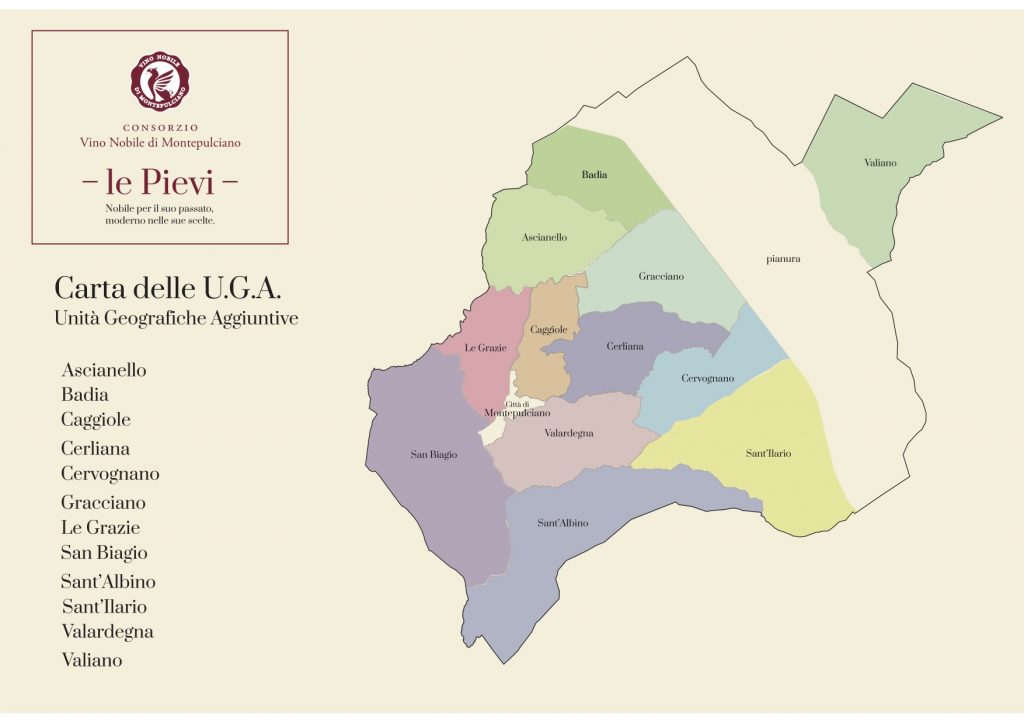
Map via: consorziovinonobile.it/zonazione-en

Map via: consorziovinonobile.it/zonazione-en

Newsflash: twelve new pievi (zones) have been approved within Italy’s Vino Nobile di Montepulciano DOCG. The update will be official as of the 2021 vintage, with the first pieve-specific wines hitting the shelves later this year.

This update was first announced several years ago and ratified within Italy as of February of this year. Finally, the EU granted their approval and published an updated disciplinare in the EU Journal on May 15, 2025. It’s now official all-around.

Located within Tuscany’s province of Siena, the Vino Nobile di Montepulciano DOCG (established in 1980) is approved for dry red wines produced using a minimum of 70% Sangiovese grapes (known locally as Prugnolo Gentile). With this newly-approved amendment, the appellation now allows for three quality levels, each with increasingly stringent standards as to yield, alcohol levels, and aging (among other requirements). These three levels are: normale (an unofficial term but often used to refer to any wine without one of the two specific terms that follow), riserva, and pieve.

Logo via: consorziovinonobile.it/

Logo via: consorziovinonobile.it/

For reference, here is a quick comparison of some of the appellation’s standards:

  • Varietal composition:
    • Normale: Minimum 70% Sangiovese (Prugnolo Gentile)
    • Riserva: Minimum 70% Sangiovese (Prugnolo Gentile)
    • Pieve:  Minimum 85% Sangiovese (Prugnolo Gentile)
  • Minimum alcohol by volume (abv):
    • Normale: 12.5%
    • Riserva: 13%
    • Pieve: 13%
  • Maximum yield:
    • Normale: 8,000 kilograms of grapes per hectare
    • Riserva: 8,000 kilograms of grapes per hectare
    • Pieve: 7,000 kilograms of grapes per hectare
  • Aging:
    • Normale: Minimum aging of at least two years; of these, at least one year must be in wooden containers
    • Riserva: Minimum aging of at least three years; of these, at least six months must be in the bottle
    • Pieve: Minimum aging of at least three years; of these, at least one year must be in wooden containers and at least one year must be in the bottle

The 12 pievi are based on the traditional parishes of Montepulciano, many of which date back to the 1700s. To use a specific pieve on label, the vines must be at least 15 years old and the wine must be made from grapes grown exclusively within the designated pieve.  The new pievi are as follows: Ascianello, Badia, Caggiole, Cerliana, Cervognano, Gracciano, Le Grazie, San Biagio, Sant’Albino, Sant’Ilario, Valardegna, and  Valiano.

We’ll be on the lookout for Vino Nobile di Montepulciano DOCG labeled with a specific pieve to be released later this year!

References/for more information:

Post authored by Jane A. Nickles…your blog administrator: jnickles@societyofwineeducators.org
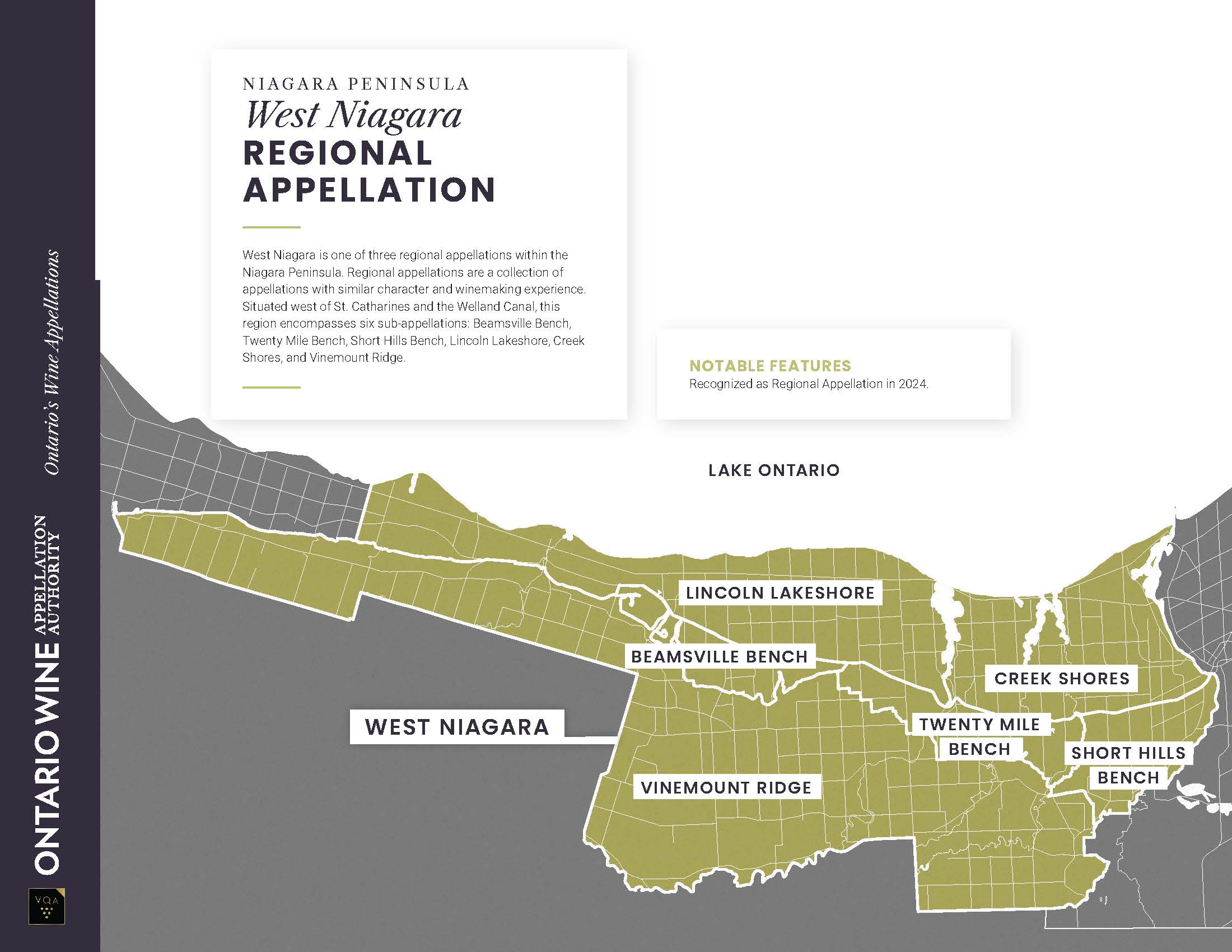
Welcome to the World, West Niagara VQA!

Map via the Ontario Wine Regulation Authority

Map via the Ontario Wine Regulation Authority

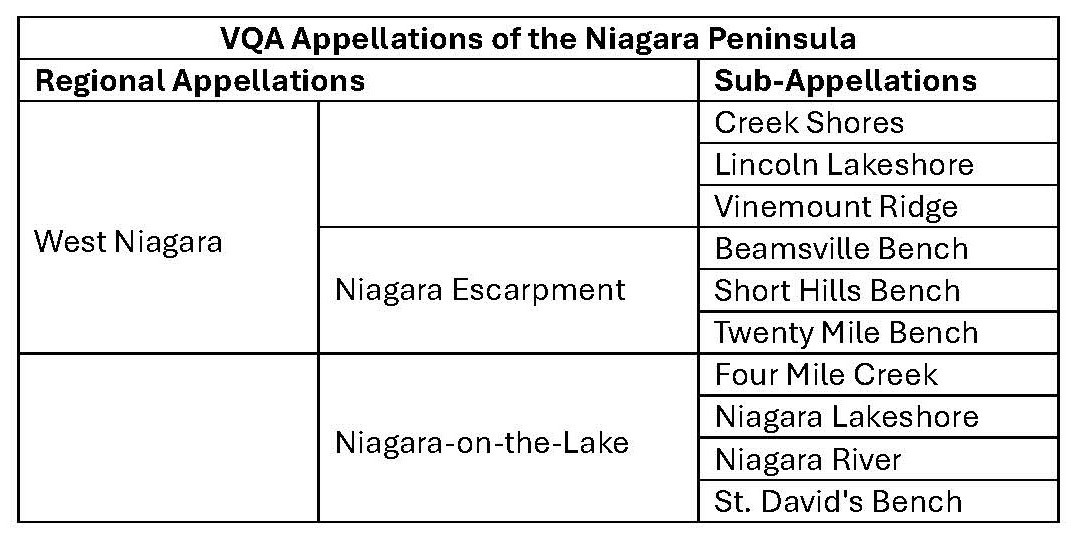
The West Niagara VQA (as defined by the Vintners Quality Alliance) has been approved as a regional appellation located within Canada’s Niagara Peninsula wine region. As such, it joins the previously approved regional designations of Niagara Escarpment VQA and Niagara-on-the-Lake VQA as the third regional appellation within the larger Niagara Peninsula VQA. These and other appellations in Ontario are defined and enforced by the Ontario Wine Appellation Authority.

The West Niagara VQA encompasses much of the vineyard area of the Niagara Peninsula located to the west of the city of St. Catharines and the Welland Canal. It contains several (previously approved) VQAs as sub-appellations. These include those within the regional Niagara Escarpment VQA (including Beamsville Bench VQA, Twenty Mile Bench VQA, and Short Hills Bench VQA), as well as Lincoln Lakeshore VQA, Creek Shores VQA, and Vinemount Ridge VQA.

The West Niagara VQA is a large area that includes rolling hills, steep cliffs, south-facing ridges, and the Lake Ontario shoreline. While the topography is diverse, the vineyards are collectively influenced by proximity to the Niagara Escarpment, the Niagara River, and Lake Ontario. Situated at 43°N latitude, the West Niagara Region enjoys an overall cool climate (somewhat moderated by Lake Ontario) along with a long growing season characterized by substantial sunshine.

The West Niagara VQA contains close to 40 wineries. The leading grape varieties include Riesling, Chardonnay, Vidal Blanc, Gamay, Pinot Noir, Cabernet Franc, Merlot, and Cabernet Sauvignon.

References/for more information:

Canada West Niagara_Page_2

Post authored by Jane A. Nickles…your blog administrator: jnickles@societyofwineeducators.org
Dispatch (and Vino Brisado) from the Manchuela DO!

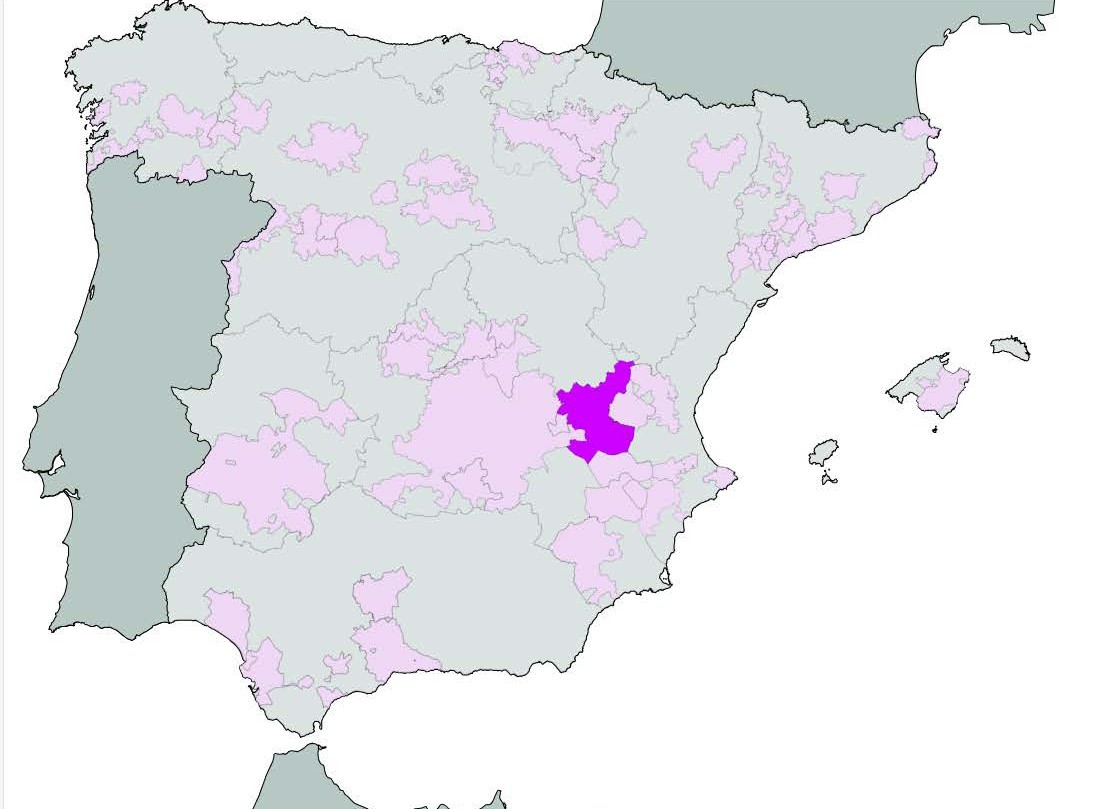
Manchuela PDOTucked alongside the massive La Mancha DO, Manchuela is a fairly large, landlocked wine region poised on the eastern edge of Spain’s comunidad autónoma Castilla-La Mancha. Manchuela is, in many ways, similar to the La Mancha DO and was previously part of the larger region. However, in 2000 the DO split off to forge its own identity. The name reflects this history: Manchuela, literally means “lesser La Mancha” or “little La Mancha.”

The Manchuela DO produces wine in a range of styles, with a focus on red wines (tinto). These wines are typically based on well-known Spanish red grapes such as Bobal, Cencibel (Tempranillo), Monastrell (Mourvèdre), and Garnacha (Grenache). Small amounts of Cabernet Sauvignon, Merlot, Malbec, and Syrah (among others) thrive here as well. Red wines may be bottled as young wines, aged wines, fermentado en barrica (oak-fermented wines), and roble (wine aged in oak).

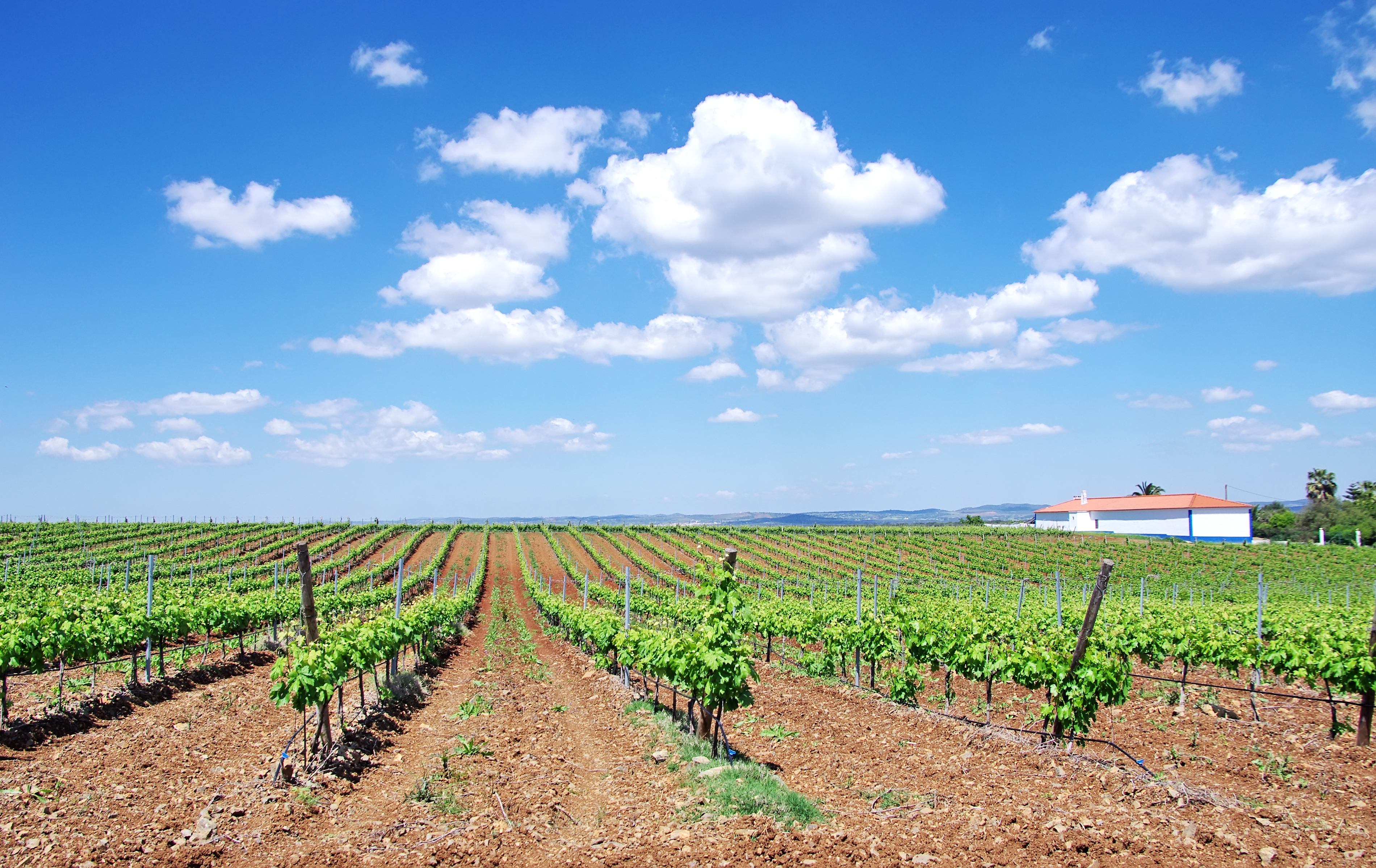
vineyard at south of Portugal, Alentejo regionWhite wines may be produced using an impressive list of grapes, which includes Macabeo (Viura), Albillo Real, Chardonnay, Moscatel de Grano Menudo (Muscat Blanc à Petits Grains), Pardillo, Sauvignon Blanc, Verdejo, and Viognier. The white wines of the Manchuela DO are produced in several styles, including young, aged, oak-fermented and aged in oak. Recently, the appellation approved vino brisado for production in the area as well.

Map of the Manchuela DO via WikiMedia Commons (CNU Free License)

Map of the Manchuela DO via WikiMedia Commons (CNU Free License)

Vino Brisado de Manchuela DO is a type of orange wine (or amber wine—both terms are used in the official documentation). While this type of wine is newly approved under the rules of the appellation, amber wines (based on the typical white grape varieties of the region) are traditional to the region.

Vino Brisado de Manchuela DO is intended to show a range of colors from amber to deep orange, resulting from skin contact during fermentation. The wine is required to have “clean primary aromas and a discernible structure.” We are looking forward to trying these amber wines, as soon as they arrive on the market!

Sparkling wines, sweet wines, ice wine, and rosado (rosé) are also produced in the Manchuela DO.

Welcome to the world, Vino Brisado de Manchuela DO!

References/for more information:

Post authored by Jane A. Nickles…your blog administrator: jnickles@societyofwineeducators.org